
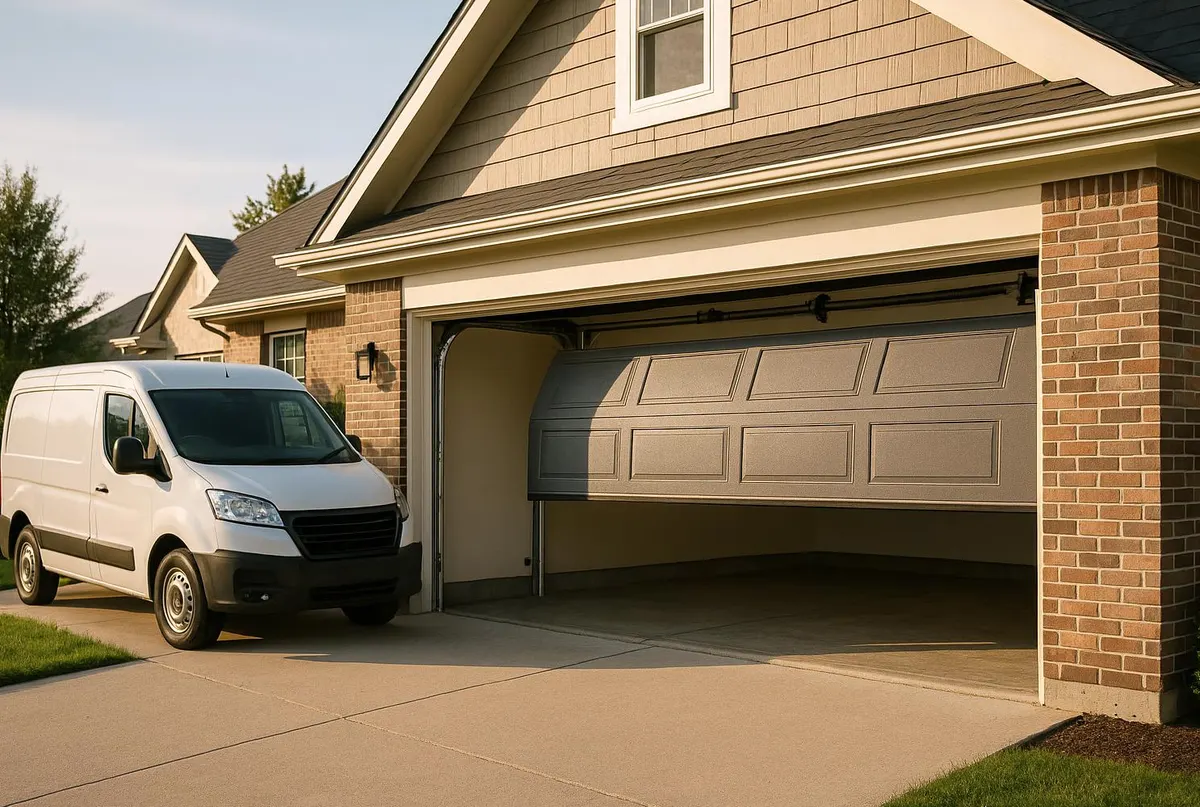
You're digging through the garage for the recycling bin on a warm October afternoon, and you brush your hand against the inside of the door panel. It's warm enough that you pull back. Your spouse says that's proof you need an insulated door. You say the garage was never meant to be comfortable—it's for the car, the bikes, and the stuff you haven't dealt with since the move. Nobody wins, and this is the third time you've had this argument. Here's what actually settles it.
What R-value Actually Measures
R-value measures how well a material resists heat flow. The higher the number, the slower heat moves through it—in either direction, hot or cold. A standard single-layer steel garage door has almost no insulating value, often close to R-0 to R-2. Doors with a polystyrene insulation layer typically land around R-6 to R-9. Doors with injected polyurethane foam between two steel skins can reach R-12 to R-18 or higher, depending on thickness and construction.
One catch: the R-value on the spec sheet is a lab number, measured with the door sealed perfectly in a test frame. Real-world performance depends just as much on the weatherstripping at the bottom, sides, and top, and on how snugly the door sits in its track. A high-R door with gaps around the edges or worn-out seals won't perform anywhere near its rated number.
Who Actually Benefits
- Attached garages that share a wall with a bedroom, laundry room, or home office. Heat and cold move through that shared wall, and an insulated door slows it down.
- Converted garage spaces used as a gym, workshop, or office, where you're actually spending time and want the room to hold a comfortable temperature.
- Garages that catch full afternoon sun, which is common on south- or west-facing homes in the hotter inland pockets of the South Bay. A dark steel door baking in direct sun all summer radiates real heat into the garage; insulation blunts that.
- Anyone bothered by noise from a street-facing door—the foam core deadens sound from both the door operating and outside traffic.
- Households dealing with dust and wildfire smoke season. Insulated doors are almost always built with tighter panel seams and paired with better weatherstripping, which keeps more of that dry-season dust and smoke out of the garage.
Who's Paying for Nothing
- Detached garages used purely for storage, with no shared wall to a living space. There's no adjacent room benefiting from the insulation, so the upgrade is mostly cosmetic.
- Garages with leaks elsewhere. If the real problem is gaps around the jambs, a loose or warped track, or missing weatherstripping, an insulated door won't fix that. You'll spend money on R-value and still feel drafts.
- Unconditioned garages where you rarely linger. If nobody's working out or working in there, the comfort payoff is small. The bigger wins in that case are dent resistance and a quieter door, not climate control.
The Trade-offs Worth Knowing
Insulated doors generally cost more than single-layer steel, with pricing climbing as you go from single-layer to double-layer to triple-layer with polyurethane—expect a noticeably wider range than a basic uninsulated door, since material and construction vary a lot between tiers.
Weight is the part people forget. Insulated doors are heavier because of the added steel and foam layers. That matters because your torsion springs and opener are sized for a specific weight range. Swap in a heavier insulated door without re-rating the springs, and you'll get premature spring failure or an opener straining to lift a door it wasn't matched to.
Also, you generally can't retrofit true insulation into an existing single-layer door. Reflective foam-board kits exist, but they're a stopgap—nowhere near the performance or durability of a factory-insulated door with bonded foam between steel skins.
When to Call San Jose Garage Door Specialists
If you're weighing an upgrade, it's worth having someone look at the actual garage—which walls are shared, which way the door faces, what shape your current door and weatherstripping are in—before you spend money on R-value you might not use. We handle full Garage Door Installation when an insulated upgrade makes sense, and we pair it with Spring Replacement whenever a heavier door means the existing springs are no longer correctly rated. We'll also tell you flat out when insulation isn't the fix and the real issue is sealing or an aging opener.
If your garage runs hot in the afternoon, feels drafty when the winter rain rolls in, or you're just tired of arguing about it, give San Jose Garage Door Specialists a call. We work throughout San Jose, Campbell, Los Gatos, Saratoga, Cupertino, Santa Clara, Milpitas, and Morgan Hill, and we'll give you a straight answer on what your garage actually needs.